In simple terms, MCP is a universal standard that lets AI models safely and easily talk to external tools and data sources.
You ask a chatbot to “check my calendar and email Priya to move our meeting.” It writes a lovely, confident message explaining that it can’t see your calendar, doesn’t have access to your email, and suggests you do it yourself. The model is brilliant at language and useless at the one thing you actually asked for.
That gap between a model that can talk about the world and one that can act in it is the problem the Model Context Protocol was built to close. If you’ve heard people call MCP “the USB port for AI” and weren’t sure what that meant, this post is for you. No prior knowledge assumed beyond a rough idea of what a chatbot is.
Here’s what you’ll get: a plain-English explanation of what MCP is, a look under the hood at how it’s put together, why its design is cleverer than it first appears, an honest list of its weak spots, and a grounded answer to the question everyone’s actually asking: is this thing catching on, or is it already going out of fashion?
The mess MCP was invented to clean up
Picture an AI assistant as a smart new laptop. On its own it’s powerful, but it can’t do much until you connect it to things: a printer, a hard drive, a camera, your phone. In the old days, every one of those connections needed its own special cable and its own special socket. Printer cable here, monitor cable there, a different one for the mouse.
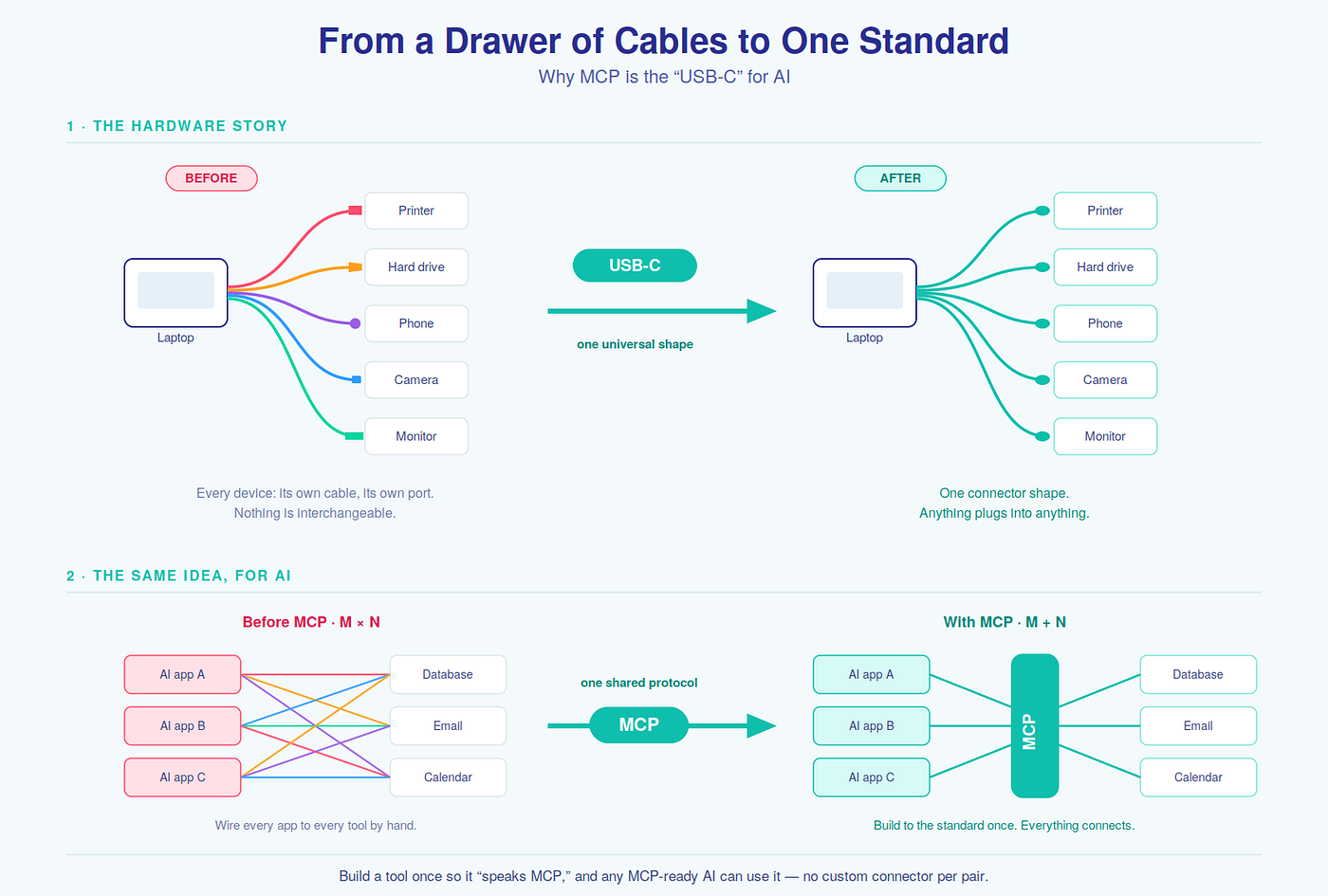
Image Generated by AI
AI tools spent their early years in exactly that state. If a company wanted its assistant to read from a Postgres database, someone had to hand-build a connector for that. Want it to post to Slack as well? Build another one. Pull files from Google Drive? A third. Now do that again for a different AI model, because the connector you wrote for one didn’t necessarily work with another.
The maths gets ugly fast. With M different AI applications and N different tools, you’re staring down roughly M × N custom integrations to wire everything to everything. Each one is fiddly to build, easy to break when an API changes, and a chore to maintain. Whole afternoons disappear into glue code that does nothing interesting. It just makes two pieces of software shake hands. MCP is an attempt to replace it with a single standard plug.
So what is MCP, in plain terms?
The Model Context Protocol is an open standard, a shared set of rules for how an AI application interacts with external tools and data. It was created by Anthropic and released as open source in late 2024.
Anthropic’s own way of describing it is that MCP is like a USB-C port for AI applications. Think about what USB-C actually did for us. Before it, you needed a different cable for your phone, your camera, and your external drive. After it, one connector shape works across all of them. You don’t think about whether your laptop supports a particular brand of hard drive. If it has a USB-C port and the drive has a USB-C plug, they just work together.
MCP aims to be that single, agreed-upon shape for AI. Build a tool once so it “speaks MCP,” and any AI application that also speaks MCP can use it, no bespoke connector required for each new pairing. Build the AI application to speak MCP once, and it can reach for any MCP-compatible tool out there.
A small honesty note, since people who know hardware will object: the USB-C comparison is a vibe, not a precise technical claim. USB-C is a physical plug while MCP is a software messaging convention. The metaphor is useful for getting the gist and slightly misleading if you push on it too hard. Even Anthropic’s metaphor has been called “problematic” by commentators who otherwise like the protocol.
What’s under the hood
MCP has a small cast of characters. Once you can name them, most explainers stop being confusing.
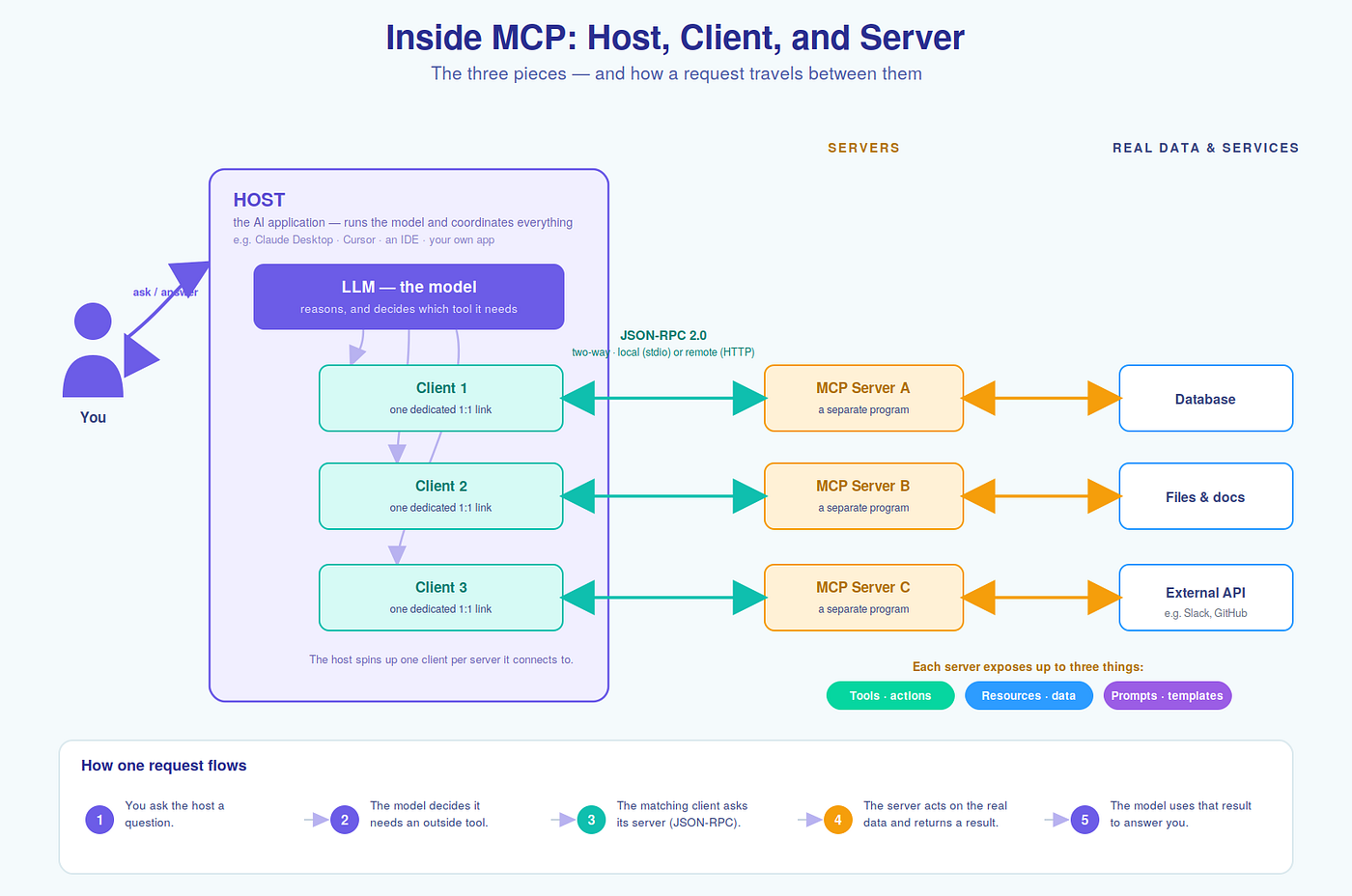
Image Generated by AI
The three players
The host is the AI application you’re actually using, the thing the model lives inside. Claude Desktop is a host. So is an AI-powered code editor like Cursor, or a custom app a company builds for its own staff. The host is the laptop in our analogy, the place where everything plugs into.
The client lives inside the host and handles the talking. You almost never see it or think about it. Its one job is to maintain a connection to a single server and pass messages back and forth in the right format. A host can run several clients at once, one for each thing it’s connected to.
The server is where the useful capability lives. An MCP server is a small program that exposes a specific power. This is the peripheral: the printer, the hard drive, in USB terms. It’s also where most developers spend their time, because building a good server for a real tool is the interesting part.
So the shape is: one host, running one or more clients, each client holding a one-to-one connection to its own server. Underneath, the messages travel in a structured format called JSON-RPC 2.0 (you don’t need to memorise that, just know it’s a tidy, agreed-upon way of saying “please run this” and getting an answer back).
The three things a server can offer
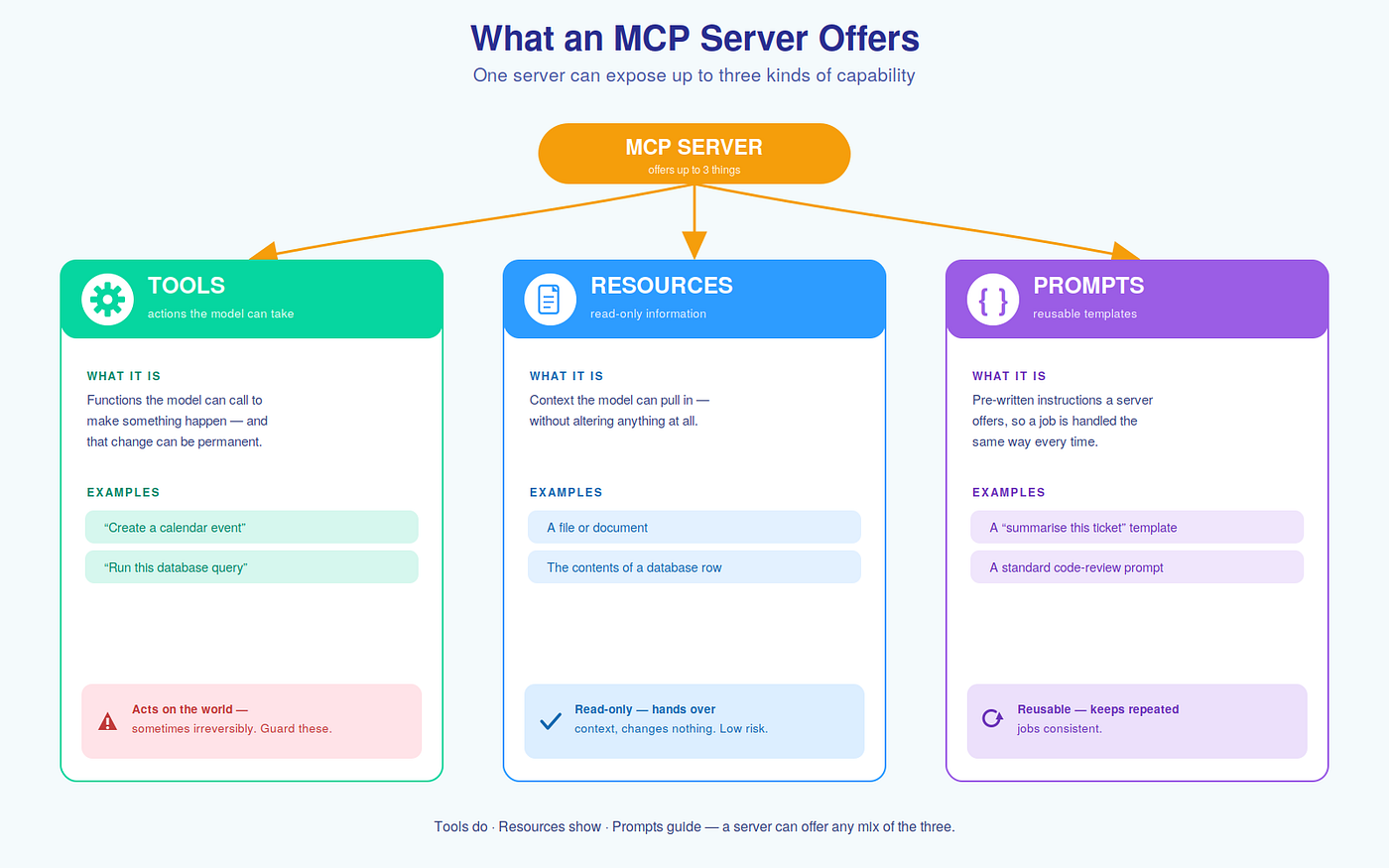
Image Generated by AI
A server doesn’t just do one kind of thing. It can expose up to three flavours of capability:
- Tools are actions the model can take. They are the functions they can call, like “create a calendar event” or “run this query.” These do something, sometimes something irreversible, so they’re the ones to be careful with.
- Resources are read-only information that the model can pull in, like a file, a document, or the contents of a database row. They hand over context without changing anything, which makes them the low-risk option.
- Prompts are reusable templates that are pre-written instructions a server can offer so the model handles a particular job consistently.
The real trick: decoupling
In the old M × N world, your AI application and your tools were coupled, i.e., tightly knotted together by custom code that knew specific things about both sides. Change the model, and you risk breaking the tool connections. Change a tool, and you might have to go patch every model that used it.
MCP slides a standard layer in between, and the knot comes undone. The model side only has to know how to speak MCP. The tool side only has to know how to speak MCP. Neither needs to know anything specific about the other. So the painful M × N explosion of custom connectors collapses into something far gentler: roughly M + N. Each application learns the protocol once. Each tool learns the protocol once. Then they all interoperate.
What does that buy you in practice? A few concrete things:
- You can swap the brain without rewiring the body. If you decide to move from one AI model to another, the tools you built still work, because they were never tied to the old model in the first place, they were tied to MCP.
- You can add a tool once and have it light up everywhere. Write a solid MCP server for your internal ticketing system, and every MCP-capable assistant in the company can use it without a fresh integration project each time.
- Because servers are independent programs, teams can build and maintain them separately. The team that owns the database can manage its MCP server and update it on its own schedule, without coordinating a release with the team that owns the AI app.
That separation of each piece being able to change on its own without dragging the others along is what decoupling means, and it’s the quiet reason the protocol is worth caring about.
Where MCP falls short
MCP is not without any flaws. There are several real concerns worth knowing before you build anything important on top of it.
- Security: This is a big one. When you let a model call tools that can act on real systems, you’ve created a new surface for things to go wrong. Researchers have repeatedly found deployed MCP servers with weak or missing authentication, meaning an exposed server could be poked at by people who shouldn’t have access. There’s also the subtler problem of prompt injection: a tool’s description, or data it returns, can contain hidden instructions that try to hijack the model’s behaviour. This is an active area of research, not a solved problem. If you deploy a server beyond your own machine, authentication, least-privilege access, and requiring explicit user approval for sensitive actions aren’t optional extras.
- Performance cost: Routing everything through a structured messaging layer adds a little overhead compared with a model calling a function directly inside its own process. For most uses you won’t notice. For latency-sensitive work, the extra hop can matter and is worth measuring.
- Quantity over Quality: Public directories now list thousands of MCP servers, but a long list tells you little about how many are well-maintained, secure, or production-ready. Some critics argue that plenty of things being packaged as MCP servers didn’t need to be servers at all. Picking a server off a marketplace deserves the same scrutiny you’d give any third-party dependency.
Is MCP winning, or quietly fading?
The short version: as of early to mid-2026, MCP is not fading. It has spread well past its origin as one company’s tool. The clearest signal is cross-vendor adoption. A standard only becomes a standard when rivals agree to it. OpenAI committed to supporting MCP across its products in early 2025, and other major players including Google and Microsoft moved to support it as well. When competitors adopt the same plug, that’s the strongest evidence that it’s becoming a shared default rather than a single firm’s pet project.
A second signal is governance. In late 2025, Anthropic handed MCP over to an independent foundation under the Linux Foundation umbrella, co-founded with other industry players. Donating a protocol to a neutral body is what you do when you want it to outlive your own roadmap and be trusted by competitors, a sign of confidence in its future, not retreat.
On raw usage, the public figures point sharply upward. Anthropic has reported that the official SDKs reach tens of millions of downloads a month, and that the count of public servers is in the low tens of thousands.
That said, the honest picture includes skeptics. Some practitioners have openly questioned whether MCP is an over-hyped standard that will lose steam once the novelty fades, and pointed out that marketplaces full of servers don’t prove widespread production use. Survey data on how many organisations run MCP in real production, rather than experiments, suggests meaningful but far-from-universal adoption. MCP has clearly crossed from curiosity into serious, multi-vendor infrastructure, while still working through the security and maturity problems that any young standard faces. The current direction of the industry is to treat agent-to-tool connectivity as something worth standardising, and right now, MCP is the leading candidate for that standard, not a fading one.